This post examines how Wikipedia users can assess a page’s strength by analyzing its View History and Talk pages. These tools help users understand the page’s evolution and the identities and backgrounds of the editors who contributed to its development. The digital humanities Wikipedia page and screenshots from this page are used as examples.
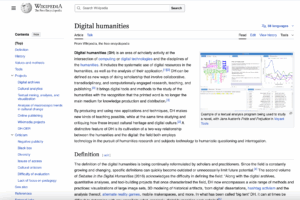
Wikipedia calls itself “the free encyclopedia,” which it is at its core. This crowdsourcing project includes tools that, by design, provide checks to the legitimacy of the site entries, including the View History and Talk pages. The View History and Talk pages of a Wikipedia entry provide users with access to the entry’s back end, enabling greater understanding of the page and the editors who shaped its development over time.
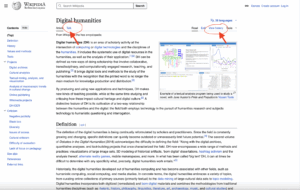
The View History page provides users with information about an entry’s origin and evolution, including its date and time of origin and its initial author and contributing editors over time. This page also provides users with access to the identity, background, and qualifications of page editors. This page also provides users with access to Page Statistics. This external tool shows patterns in edits to the entry, including the number and timing of edits, as well as editors’ activity patterns. A user can also use the Compare link within this page to view and compare entry revisions made over time.
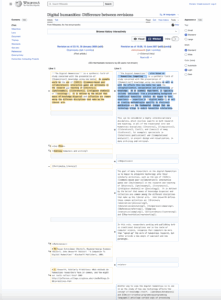
Analysis of the View History content of the Digital Humanities page reveals that this entry was posted on January 30, 2006, by user Elijahmeeks.
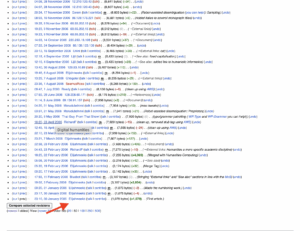
By clicking the profile link under this user’s name, we see that he is a digital humanities expert at Stanford University and studied Wikipedia and open-source culture.
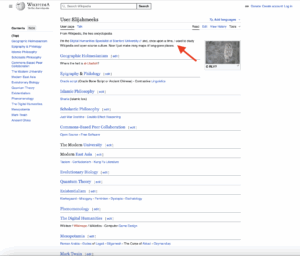
The inaugural page was sparse, featuring only a brief four-line definition of Digital Humanities (DH). However, in less than two years, the page reflected significant enhancements, including a refined definition of DH, and sections on Objectives, Lens, Document, Themes, Standards, an expanded list of References, and External links. There is also a link to access Humanities Computing Projects.
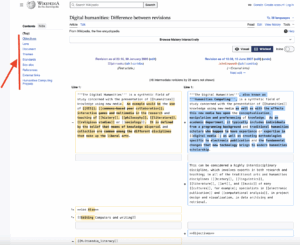
These changes, and those that would follow, were made possible through crowdsourcing and input from the top dozen editors on this page, who represent a diverse range of backgrounds, experiences, and expertise in the field of digital humanities. This group includes current students, graduates, distinguished professors, a veteran Wikipedia editor, and a librarian. Contributors to this page include editors who specialize in digital culture, Wikipedia studies, and digital culture. Most importantly, these editors represent diverse viewpoints and expertise, providing them with the lens and knowledge to meaningfully contribute to the editing process of the digital humanities page.
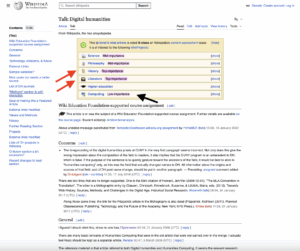
The transparency in developing a Wikipedia entry is an integral part of the Wikipedia project. This transparency is facilitated through the Talk page, which allows users to view a page’s editing history. This feature is designed to enhance transparency and build user confidence in the information presented. The Talk page provides a forum for editors to discuss, debate, and resolve disagreements about an entry’s content, and to communicate proposed changes to an entry. Some early discussions on this page focused on differentiating digital humanities from humanities computing, which are conflated. Another topic was on the organization of the page by issues.
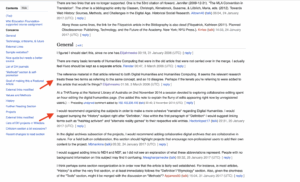
Interestingly, topics related to History and Literature generated the most controversy, while issues on computing generated the least debate. These differences might reflect the technical backgrounds and expertise of the top editors who made the most significant contributions to the page.
The process of deconstructing the digital humanities Wikipedia page highlights the limitless possibilities of crowdsourcing to develop open-access Wikipedia pages, particularly when contributors include editors with a range of backgrounds and expertise relevant to the topic.