All posts by admin
Searching: Fifth Piece of the Puzzle
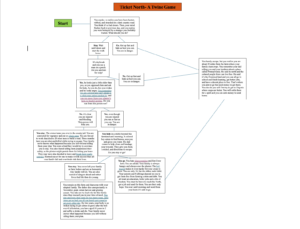
I am still listening to oral histories from the Goin North digital humanities project and mapping the structure of my final project, a Twine game about the Great Migration, targeted at high school students who live on the Main Line. The purpose of this project is to teach students aspects of historical thinking, including analysis of primary sources, multiple accounts and perspectives, and sourcing. Students will have the opportunity to assume a character of their age and navigate the journey. One of the key challenges is finding concentrated blocks of time to sit and work uninterrupted. My goal is to complete the course assignments and turn off my phone during peak time blocks each day to make greater progress.
The readings this week on generative AI, particularly the writings of Cohen (2025) and Kelly (2025), provide strong arguments for the advantages of using AI in research and writing. These insights have motivated me to consider using Gemini during this midstage of my work to review my draft for feedback. I am also considering using this tool to transcribe handwritten primary documents for the project, so students can more easily understand the text.
Cohen (2025) and Schaul, Chen, and Tiku (2023), however, provide caution against expecting AI outcomes to be produced by a system capable of reasoning. Instead, their writings point out that AI-generated results are based on vast amounts of text they are trained on, often without transparency about the sources, so the results mimic human speech. I will need to consider the results in this context.
The readings this week also highlight an important point about AI-generated content and student learning, especially concerning student essays, which are already considered an ineffective means of assessing student understanding (Sample & Schrum, 2012). When combined with generative AI, which can help students write essays without understanding the material or what they are submitting, this assessment method loses even more significance in education (Christman, 2025). The solution is for educators to incorporate generative AI into their teaching practices, so students can critically evaluate the content produced (Christman, 2025; Mills, 2025). I plan to incorporate these practices in my teaching moving forward.
Media Consuming and Creating: Fourth Piece of the Puzzle
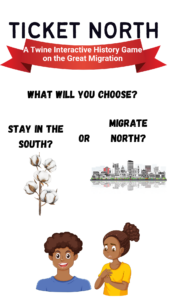
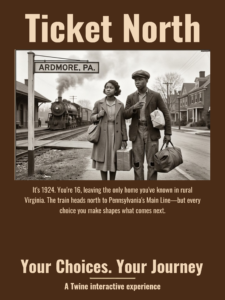
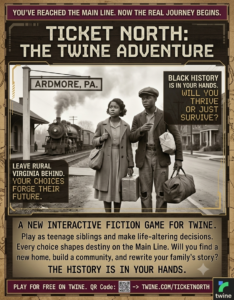
Below are three flyers I created to present my project to its intended audience of high schoolers. These flyers were created using traditional, AI-hybrid, and exclusively AI-generated content. The transformation of the flyer content demonstrates the range of agency users have while using digital tools alone, standard tools augmented with AI-generated content, and AI-generated content exclusively. The second flyer is the flyer I would select for my intended audience.
Flyer 1- Game Flyer Canva Alone. I was able to create a flyer with minimal wording and graphics, but had limited options for visual elements, like the images of the young people. The result is a flyer that looks like it is intended for a much younger audience than it is. In addition, the process of creating this flyer was considerable.
Flyer 2- Game Flyer Canva augmented with an AI-generated image. In this flyer, I had better control in designing my graphic image and flyer background. The result is a flyer that has an aesthetically pleasing look. I spent the least amount of time creating this flyer.
Flyer 3- Game Flyer Gemini-generated Content. This flyer was designed using a prompt specific to the goals of creating a minimally worded flyer for the game and realistic images of two people. The image required an additional 8 edits in the prompt to generate the final poster. Each edit changed elements of the flyer that I liked to elements that I did not request, which was frustrating. The resulting flyer is much wordier than I envisioned. The environmental issues associated with using AI-generated content were a major concern, so I settled on this flyer design rather than continuing to edit it.
Media-Consuming and Creating
As a history educator, I would use film to help students gain a deeper understanding of the historical background of the Great Migration, as the medium offers insights into the period through characters’ experiences and the plot. I would require students to watch the 1995 film adaptation of August Wilson’s play “The Piano Player,” a fictional story set in Pittsburgh in the 1930s, during the Great Migration and the Great Depression. The film centers on two siblings’ struggle over the future of a family heirloom, a piano. Boy Willie wants to sell the piano to buy the land where their ancestors were once enslaved, while his sister, Bernice, is determined to keep it in the family because the images carved on the wood represent their family’s legacy. Even though this film is historical fiction, it can be valuable in helping students see the lived experiences of African Americans during this time period.
I chose this film because it delivers a strong portrayal of the daily lives of working-class African Americans who migrated to Pittsburgh during this period. This film taps into the emotional, financial, and personal challenges African Americans faced as they resettled in the North during the Great Migration. The migrants’ fears during this transition are also brought to life through the actor’s interaction with the heirloom piano, which is a character and seems to symbolize the spirit of their ancestor’s former enslaver. As the plot unfolds, we are introduced to the film’s main conflict- the fate of the piano.
The main characters present viewers with two distinct choices, each representing the opposing views that African Americans faced during the Great Migration- should they stay in the South and rebuild their lives, or should they go North? By presenting these opposing perspectives, the film illustrates the complex decisions made by those who migrated. Students will hopefully be encouraged to reflect, discuss, and even argue about the choices and sacrifices those who experienced the Great Migration might have made. In so doing, the choice of a historical film can enable students to critically examine the narrative and be moved to respond to what they have seen (Davis, 2000).
I would also incorporate scholarly digital storytelling into the history education context by giving students the opportunity to create a digital project on the Great Migration using digital tools. Students will have the opportunity to select one person, region, or event from the Great Migration to highlight in their story. I would provide students access to primary sources that provide multiple accounts and perspectives to read and analyze. I would also engage students with the materials to help them not only understand the historical context of the sources but also see them through the lens of “uncomfortable strangeness,” with the goal of motivating their inquiry and, hopefully, prompting them to ask questions. In their work, students would be tasked with using primary sources to support their arguments and have opportunities to develop historical thinking skills as they create their projects.
Images: Third Piece of the Puzzle
At this stage of my project, I have immersed myself in reading articles and blogs on game design, particularly the writings of academics who use Twine to teach history. I have also spent time watching videos on designing Twine games. Additionally, I have identified and played several Twine games, including Ponce’s Surviving History: The Fever! and Quinn’s Depression Quest, for game design ideas.
I need to learn more about Twine’s technical parameters. I have discovered that the images used in my game must be web-based. I want to learn more about specific site locations to identify publicly accessible visual sources for my game. I need to research more about the day-to-day lives of African Americans living on the Main Line.
Most of the primary sources I am finding are in Black church archives and the homes of long-time Black Main Line residents. I am also meeting with long-time Black residents willing to share their memories of living on the Black Main Line.
I plan to use a publicly available 1926 fire map of South Ardmore, along with AI-generated images of people and some primary sources from Main Line Black church archives. I am interested in seeing examples of game design workflows mapped out, but I am not certain where to find any to review. Time playing on Twine has been the biggest challenge I am experiencing. My next steps include drafting the game scenario flow for my Twine game.
This 1926 G. W. Bromley and Co. fire map captures South Ardmore, the area where African Americans were concentrated.
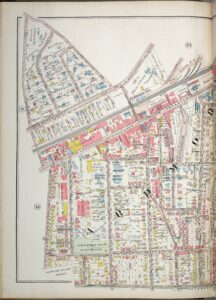
I am including a map in my project because, as a representation of space, maps do not just reflect the reality of a location; they create it (Seager). This map is one of many produced by companies for insurance companies to assess property risks. Maps like this documented a town’s physical structures, including businesses and homes, all by address and, for homes, by the homeowner’s name.
I will provide contextual information about the map for my audience, including the map’s creator, year of creation, and reason for its creation. I will help the intended audience analyze this source by identifying the names of the four streets where African Americans were primarily concentrated and the number of African American families living on these streets.
This historic map documents the history of African Americans in this section of Ardmore by identifying the names and locations of its three houses of worship and York Nelson’s homeownership, which belonged to one of the town’s most influential community members. It also shows the proximity of these locations and provides viewers with insight into how residents in Ardmore’s Black community might have navigated living in their enclave while navigating the town’s geographical boundaries in relation to other institutions, including Haverford College and the Auto Car manufacturing company.
The History of History Teaching: Second Piece of the Puzzle
Digital media and tools are an effective way to target my audience on history and historical thinking, based on information I gained at a recent conference at Swarthmore College and from viewing the 2021 conference panel video, “Taking Video Games Seriously.” Both stressed the need for educators to consider games as a pedagogical tool for research and teaching, given Americans’ insatiable appetite for video games, much of which is rooted in historical themes. Importantly, my target audiences, Gen Z and Millennials, have years of experience in video game culture.
Teaching students the history aspect of my project topic is secondary to getting students to engage in historical thinking, a process of critically examining historical materials to construct a more accurate and complete picture of events. This process will require that I provide students with multiple accounts and perspectives, help them learn to analyze and ask questions about historical sources, help them understand the historical context of sources, and help them make the connection between a claim and its supporting evidence.
This tool can also provide students with a different medium for engaging with historical materials from the turn of the century to analyze and raise questions about this time. Further, the use of this medium can help students consider that the area they are familiar with today would have been quite different and unfamiliar at the turn of the century.
Twine uses a role-playing, linear-based design, and this component requires me to carefully design my game to meet the goal of historical thinking. an. To make it an effective game, I need to scaffold my game, recognizing that students will come to it with different experiences and expectations. I also need to consider my game’s design by first establishing its argument and then aligning the design to support the narrative and mechanics of that argument.
The above process I explained means I need to focus more narrowly on my project’s intended audience, so the content will engage this specific audience in design choices (Kirilloff, 2021). I will include a character who reflects this age group and offer options that are realistic for a person of this age to experience.
The History of History Teaching
History, as a discipline, is recognized as a constructed explanation of narratives based on fragmented, incomplete evidence that is subject to revision (Calder & Steffes, 2016). To construct narratives, historians use distinctive ways of thinking and practices that guide how they interpret and use evidence to explain the past through historical thinking. Further, the historical thinking, as an epistemology, allows historians to understand how knowledge is constructed and what it means (Lévesque).
Historical thinking, the use of critical thinking skills to make sense of evidence not easily shaped into narrative, is challenging and has even been described as an “unnatural” act (Wineburg, 1999), as it requires students to engage with the subject matter at cognitive levels that challenge one’s routine way of processing information. This process is needed to position students with an uncomfortable sense of strangeness toward the past, so we move beyond our false sense of proximity to the people and places of the past (Wineburg, 1992; Wineburg, 1999).
Educators have used the core elements of historical thinking over the decades to help students navigate the complexities of historical narratives and develop a deep understanding of history. The five key elements recognized by educators as foundational in helping students develop what Holt (1995) and Calder (2006) refer to as historical mindfulness include: having multiple accounts and perspectives, analysis of primary sources, sourcing and sources analysis, understanding historical context, and meeting the claims-evidence connection (Calder & Steffes, 2026; Fournier & Wineburg, 1997; Middendorf, King & Lincoln; Wineburg, Smith & Breakstone, 2018).
Scholars in teaching and learning have also modified these core components of historical thinking over time (Andrews & Burke, 2007; Calder, 2006; Furay & Salevouris, 1988; Mills, 2013; Ward, 1971); however, the elements remain at the heart of history teaching over the decades because these components move students from memorization of facts to critical inquiry.
An educator’s use of multiple, even conflicting, accounts of historical information and perspectives is essential for transforming students from passive readers of textbooks, often seen as the authority on knowledge, into active participants engaging with multiple sources of information. Students analyzing primary sources is also important, as the process encourages them to critique these documents rather than passively consume textbooks, which present other individuals’ interpretations of history as objective truth. By evaluating and analyzing sources, students learn to question the sources’ origins and the intentions behind their creation, skills essential for determining a document’s objectivity. Students’ understanding of historical context is critical for them to place an event in a specific location and time frame, allowing them to make connections among past events. Finally, students learning to make the claims-evidence connection is also critical as they learn to form an argument.
Historical thinking is important because efforts to assess students’ knowledge of history reveal that traditional methods of teaching history, lecture-based teaching, textbooks as sole reading, theme-based curriculum structure, and multiple choice assessment are ineffective in both producing students’ retention of information on standardized tests and in helping students make sense of historical information (Calder, Fournier & Wineburg, 1997; Wineburg, Smith & Breakstone, 2018). Further, this approach leaves students with surface knowledge, and underdeveloped reasoning skills to inquiry-based practices (McBrady, 2022; Santos, 2022; Ward, 2007).
The core constructs of historical thinking remain because of their effectiveness in helping students move beyond a false sense of familiarity with people from the past to viewing people and events with an “uncomfortable strangeness”, a position in which students are motivated to ask questions about the strangeness they can observe from historical content to actively generate an understanding of the past (Wineburg, 1999).
Thinking About Historical Thinking
In an increasingly fractured social, cultural, and political landscape, the significance of history as a discipline is clearer now more than ever. It is important because understanding the weight and reality of the past can help us realize the relevance of skills as citizens and humanize and unite society in ways other fields cannot (Wineburg, 1999). Far beyond Santayana’s saying that those who neglect or ignore history are “doomed to repeat it,’ historical thinking offers a pedagogical model for helping students navigate the complexities of historical narratives (Fournier & Wineburg, 1997; Middendorf, King & Lincoln). To achieve these goals, educators must move beyond the status quo, which leaves students with surface knowledge and underdeveloped reasoning skills, to inquiry-based practices (McBrady, 2022; Santos, 2022; Wineburg, Smith & Breakstone, 2018).
The struggle educators face in teaching history is straddling the gap between being content experts and working with students they assume have greater foundational knowledge of history (Middendorf, King & Lincoln). Instead, students are not only novices but also arrive in the classroom with the false belief that their lived experiences are sufficient to understand and interpret the past (Wineburg, 1999). As a result, students taking history classes become passive learners and fail to develop epistemological skills for historical inquiry, demonstrate inadequate reasoning skills when analyzing historical sources, and let cultural biases shape their understanding of the past and the future (Fournier & Wineburg, 1997; Wineburg, 1992; Wineburg, 2018).
To eliminate these barriers, scholarship in teaching and learning suggests that history educators learn to decode the discipline, recognizing historical thinking as an “unnatural act” for students, given the above-mentioned challenges (Middendorf, King & Lincoln; Wineburg, 1999). This process requires that educators identify specific “bottlenecks”, or hurdles educators need to fully address since they impede student learning (Middendorf, King & Lincoln; Wineburg, 1999). Educators model the steps for working through processing challenges, then plan and assess opportunities for students to practice these skills (McBrady, 2022; Middendorf, King & Lincoln; Wineburg, 1999). The learning process shifts from students seeking answers to students investigating and cultivating a sense of puzzlement as they engage with historical topics, formulate questions, and offer solutions (Santos, 2022). By examining primary sources through the lens of “uncomfortable strangeness,” students actively create meaning rather than passively receive it (Wineburg, 1999).
When students are taught to connect history to the present day, they are more likely to understand the challenges they face today. When students consider questions about how we want to live versus how we are living, they can use history as a source of reflection for the answers to these questions (Calder).
I have several questions about teaching history that I hope this course will address. First, as we navigate an era of rapid technological change, how should we, as educators, address the reality that students are disconnected from deep reading, which challenges their ability to engage with sources? Second, how do we design learning opportunities that are geared toward figuring out history through critical inquiry, rather than finding the “one right answer” through a Google search or, worse, the temptation of AI-generated summaries? Or, is it more realistic to leverage AI tools as pedagogical levers to expose their biases and show how they might generate false narratives, so students can learn historical thinking skills from this approach as well?
Public History Introductory Post
Hi everyone, my name is Tanya Gardner, and I am a student in George Mason’s Digital Humanities Certificate Program. I am originally from New Orleans but have lived in the Northeast for most of my life. I hold degrees in media production, human communication, and culture and media studies. In addition to my studies in public history and digital humanities, I am a professor of communication studies at Delaware County Community College.
Some of my skills include being a tenacious learner, which I am finding helpful in an online learning program. Some of my key skills in public history include an interest in understanding past events in their historical context. I also enjoy research and find the process of hunting for information interesting, like detective work. I can, and often do, happily spend hours in online archives, physical libraries, and historical societies, searching for and analyzing historical documents.
I have many interests outside of school that I use as healthy outlets to keep me balanced, including gardening (vegetables and flowers), reading (mostly literary fiction), and time with family and friends. I am also the archivist for my church and volunteer on my township’s library board. My research interests range from health communication to community resilience. I view my current focus, the history of Black communities along the Pennsylvania Main Line, as an extension of my scholarly interests, as knowledge is power in building community resilience. One of my goals in this course is to move closer to using all the knowledge I have gained in the program so far to produce a site that executes the design principles and goals of a digital humanities project.
One question I currently have is how to determine which information I have researched will interest the public. I find all the information I uncover interesting, but I need to decide which to share with the public and which to save in my records. I have also come to realize that public history often centers around the history of individuals. As I dig into my research, I see that people’s lives are sometimes complicated and messy. I want to be respectful and not tarnish anyone’s reputation, but I also do not want to perpetuate myths. I am grappling with how to handle information unearthed about individuals that is true, but could negatively affect the public’s perception of their accomplishments.
Brevity is also not my strong suit, so I also want to learn how to keep my writing concise and focused to keep the public engaged. I am interested in adapting my project across multiple teaching and learning environments, including museums, colleges, and high schools.
Portfolio Blog Post 3
This course helped me understand and develop my own approach to doing public history. It helped me understand the need for an audience-centered design, and provided me with hands-on experience using tools to build the foundations of a digital collection and an interpretive website. Some of the readings and materials were particularly helpful in shaping the choices I made for my project over the semester.
Getting acclimated to the field of public history was essential, and Townsend and Dichtl’s (2009) provided a foundational definition to help me understand the field’s parameters. Grele (1981) prompted me to consider the parallels between the historical decline of the 1980s and today’s climate of historical erasure. Contrasting these perspectives helped me to grasp the importance of public historians. Additionally, Weible (2008) helped me understand that the “public” in public history is not just the audience, but should be viewed as active participants in a process of shared authority. This realization shifted my focus to engage more with my potential audiences on the project. While this approach was time-consuming, I understood the value of collaborating with the community on every aspect of the project, from the project’s topic to its design and implementation, and its final evaluation.
As someone with a background outside history, I found Wineburg’s article especially thought-provoking. He highlights the need for teachers to invigorate how students learn history. He argues for the need for intentionality in selecting the historical documents taught to students, to help them learn to tolerate complexity and not accept the first-guessed (or AI-generated) response. Using Brennan’s Histories of the Mall as a case study reinforced the importance of starting with sources and questions to guide interpretation. Wineburg’s insights helped me understand the importance of digital projects that are interactive and engaging, making the past come to life and inspiring the public to further inquire into the topic.
Putting these concepts into practice was helpful in the content templates (Kissane, 2011) and paper prototyping (Medero, 2007). These practices were challenging but helpful. I was able to visualize the site flow a user might experience and try to identify and address interface design flaws. Even though I had insufficient time and design skills to execute the interface I wanted, I gained an invaluable understanding of this process for when I can work on team projects.
I also learned the need for shared authority in my project. Arnold and Miller (2016) and Lubar (2015) encouraged me to remove myself from the role of a traditional exhibit curator. Lubar’s principles also served as a great guide for exhibit design and the importance of providing users with high-quality, aesthetically appealing images to gaze upon. This principle sent me searching for content beyond historical newspaper articles and for replacement images of some photos of individuals highlighted in my project. His writing also reminded me of the importance of considering the community’s perspective and of their having a voice in how their history is represented and what the site does for the community.
The readings on AI-generated content and transcription were particularly useful because I was spending significant time sourcing images in the public domain. Using Gemini AI produced visually appealing images as potential Omeka banners within minutes. AI also helped me translate difficult-to-read correspondence that I will use for my site. These tools are now integrated into most digital spheres and have the potential to help public historians complete projects efficiently. While the future of AI is yet to be known, having the space in this course to apply these tools was helpful.
Finally, as a fan of This American Life, I found Ira Glass’s insights on the creative process encouraging. His reflection on the gap between our tastes in what we want and what we can produce at the early stages was a welcome reminder that improvement takes time. Doing public history takes time. I know I need to commit to this time to improve my skills.